EMT Practice Test

1. Question Content...


Question List

Question1: The most effective way of ensuring patient safety in your organization is by

Question2: A physician gives the nurse several verbal orders and blames her for missing a task. What is your opinion about this?

Question3: The most important procedure for the prevention of infection from germs and viruses is

Question4: A patient presenting with crushing central chest pain, was diagnosed to have unstable angina. He refused to receive any medication. The physician should

Question5: An injury caused by medical management rather than by the underlying disease or condition of the patient is called:

Question6: During her night shift in the ER, Dr Sara unfortunately had a needle stick injury while she was stitching a 4 years old child. All of the following measures are helpful in managing this incident except:

Question7: The concept behind PDCA is

Question8: Which of the following organizational structures would offer the best choice for business goals to be disseminated both clearly and quickly?

Question9: In face to face contact between an employee of an effective service and the customer, how does the employee gain most of their knowledge about the customer?

Question10: The most common cause of needle stick injuries is:

Question11: When a hospital does not offer a particular or certain service in order to avoid its well known risks and associated problems, this is called:

Question12: The greatest benefit of concurrent clinical review is:

Question13: The best way to teach staff about quality and performance improvement is

Question14: The technique that is used to take into account or to control the fact that different patients with the same diagnosis might have additional conditions that could affect how well they respond to treatment is called:

Question15: In the endoscopy unit, the following remarks are on an audit check list. Which of the following is considered a non-conformity regarding reprocessing of endoscopes?

Question16: The leader who follows the organization's rules exactly but usually faces issues regarding employee commitment is considered which type of leaders?

Question17: The quality pioneer is generally recognized as being the creator of the control chart is:

Question18: The available exit routes in a workplace should be more than

Question19: Your company's largest client has just completed an audit of your quality system. Three major deficiencies were identified, and you risk losing this client if the problems are not corrected. As quality manager the best plan of action is

Question20: One goal can have many

Question21: Outputs of the execution and the control phases of the project is/are:

Question22: As a quality manager in a healthcare organization, which of the following methods would you use and consider effective to improve quality in your organization?

Question23: During reading the patient's record physician found that the dose of tegretol was written as 1200 mg instead of 200 mg. The physician should:
i. Draw one line through the error.
ii. Delete the error by white ink corrector and write the correct dose over it.
iii. Write the correct dose between brackets.
IV. Report this error to the medical record review committee.

Question24: In this run chart,

The sudden change above the red arrow is due to?

Question25: All the following are organizations that accredit healthcare facilities except:

Question26: The most likely person to act as a change agent for organizational change is

Question27: Compliance with OSHA requirements according to the code of federal regulations is:

Question28: All of the following are considered a medical error except

Question29: Which person of the following is responsible for coordination of care?

Question30: The most important procedure for the prevention of infection from germs and viruses is:

Question31: All of the following is true about the Continuous Improvement Process (CIP) except:

Question32: In a moderate size hospital, which of the following organization structure would be most repressive to decision-making ability of their employees?

Question33: The most common vehicle by which micro organisms are transmitted between patients

Question34: The nurse in charge at the ICU prepared her equipment for insertion of urinary catheter for a patient, she performed hand hygiene, donned gloves and inserted the catheter. After finishing the procedure, what type of disposal bags did she dispose the gloves in?

Question35: In the ER, a patient denied any allergies to antibiotics. He developed an allergic reaction after administration of penicillin. This is considered as:

Question36: Both small and large organizations can undertake scale change. What would be a major disadvantage or draw-back that large organizations have that their smaller counterparts do not?

Question37: Eleven points on a control chart are between the lower and upper control limits, but each point from left to right is a little higher than the previous point. The chart indicates a

Question38: A hospital decided to hire new practitioners to increase the efficiency of its services. The observation and evaluation of these new practitioners is called

Question39: After a sample population is divided into two homogeneous subpopulations, each member will have an equal probability of being selected. This method of sampling is called

Question40: Project management processes can be organized into

Question41: Which of the following elements is least necessary to a good corrective action feedback report?

Question42: The leader who makes his own decisions and announce them to the group with little or no participation from the others is considered

Question43: The first person to think about systematic inquiry in the healthcare process due to variability in patient outcomes was:

Question44: Patient education may be considered as

Question45: A project is defined as

Question46: Surveys by JCAHO are considered:

Question47: This type of OSHA standard that aims at reducing the number and severity of MSDs caused by exposure to risk factors in the workplaces as awkward positions, repetition & force :

Question48: The similarities between projects and operations include all the following except:

Question49: The two major advantages of an external audit who is auditing any aspect of the organization is:
i. Knowledge.
ii. Bias.
iii. Objectivity.
IV. Independence.

Question50: In which industry did lean thinking originate?

Question51: In the surgery department audit report, which of the following is considered a breach in the infection control practices?

Question52: An organizational steering committee is usually composed of

Question53: The Infection control team in a hospital carried out a survey to estimate the incidence of health care workers colonized by MRSA. During presenting the data in a meeting of the team, what is the most important information they should look for while analyzing the results of the survey?

Question54: Inadequate leg clearance because of low surface height & sustained arm/elbow reflection are examples of:

Question55: Which of the following quality gurus are most closely associated with the terms "total quality control" and "total quality management"?
i. Crosby
ii. Feigenbaum
iii. Ishikawa
IV . Deming
V . Juran

Question56: A matrix diagram is used to show the relationship between two variables. Matrices can be developed in several ways. Which one illustrates relationship in three planes?

Question57: The proper way of disposing formaldehyde contaminated waste is:

Question58: For proper disposal of cytotoxic drugs which of the following is best?

Question59: Nurse-sensitive outcomes include all the following, except:

Question60: A hospital gives training to all staff about quality concepts. For this training to be considered effective, it must achieve

Question61: Regarding respiratory protection, the first measure to be taken is:

Question62: Which of the following respirators are considered supplied-air respirators?

Question63: The nurse in charge at the ICU prepared her equipment for insertion of a urinary catheter for a patient. To prepare the perineal area for insertion of urinary catheter she should:

Question64: Customers are very important in any business because:

Question65: Refer to Exhibit:
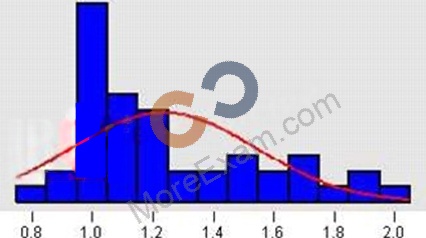
This data set is:

Question66: In the operating room there has been repeated scheduling problems. The first step you should take to solve the problem is to

Question67: Sharing resources & personnel throughout is common in which type of organizations?

Question68: The Hospital's largest insurance company has just completed an audit of your quality system. Three major deficiencies were identified, and you risk losing this insurance company if the problems are not corrected. As quality manager the best plan of action is

Question69: Which of the following is true about medical records?

Question70: A Prospective review may be beneficial in all the following except:

Question71: The most likely person to act as a change agent for organizational changes is:

Question72: During the infection control committee meeting, the infection control physician proposed to purchase a gas plasma sterilizer. Which of the following statement is an advantage of this sterilizer?

Question73: The most unlikely approach to overcome employee resistance to change is

Question74: Preventive actions have an action sequence similar to the path for corrective actions except for which of the following?

Question75: High quality, low cost efficient care is achieved through

Question76: One advantage to employees, rather than consultants, initiating change with the hospital is

Question77: Patient education may be considered in other words as:

Question78: In which of the following organization structures do people have the least decision making authority?

Question79: The maximum distance you should pass to get a fire extinguisher should not be more than

Question80: Cultural change is intimately related to

Question81: The most common cause of medication error worldwide is

Question82: The purpose of a Pareto chart is to

Question83: Both small and large hospitals can undertake large scale change. What would be a major disadvantage or draw-back that large hospitals have that their smaller counterparts do not?

Question84: "The process of evaluating overall project performance on a regular basis to provide confidence that the project will satisfy the relevant quality standards" is the definition of:

Question85: The Bolam test considers that

Question86: During the first meeting of the team some members are shy, what should the leader do to manage this?

Question87: When hospital A contracts with hospital B to transfer to it all organ transplant patients, this is called:

Question88: When a patient is harmed or when things have gone wrong, the correct thing to do is:
i. Inform the patient and his family.
ii. Correct the error without informing the patient.
iii. Ensure the process is modified to become more safe.
IV. Report the incidence nationally.

Question89: In most cases, an improvement team receives the least control and direction during which of the following stages

Question90: As a project manager, when is it appropriate to accept a project risk?

Question91: A nurse in the ER gives an antibiotic to a patient who denied any history of allergy towards drugs. After a few minutes, the patient develops a drug allergy, this is considered to be

Question92: All of the following is correct about material safety data sheets (MSDS), except

Question93: All of the following are right considering brainstorming except

Question94: For a metric to be useful, the most important factor is the

Question95: In the history of quality, the first person to think about systematic inquiry in the healthcare process due to variability in patient outcome was

Question96: A supplier system audit that focuses on the general use and planning of time, materials, and manpower would be most indicative of:

Question97: All of the following are right considering brain storming, except:

Question98: In which of the following techniques does the team leader not ask team members about their preference of potential resolution options?

Question99: Just-in-time (JIT) procurement is normally preceded immediately by

Question100: A leukemic patient came to the hospital to receive his weekly intravenous dose at the oncology unit. Which of the following practices should be carried out during the preparation of the dose?

Question101: All of the following occur during the planning process group except

Question102: The written document that is considered the teams license to operate as it defines the task, scope, time frames and boundaries the team will work in, is called:

Question103: Collection of data about diagnosis, diagnostic tests and symptoms are characteristics of